

Cost Analysis: OEM vs. Replacement Dust Collector Filters
Quick Answer:
OEM dust collector filters typically cost up to 50% more than equivalent replacement filters, yet most come from the same handful of ISO-rated U.S. manufacturers. Quality replacement filters built to OEM specifications deliver the same filter life, pressure drop, and filtration efficiency, so the savings come from eliminating brand markup, not from lower performance. Verify dimensions, media, construction, and performance guarantees before switching.
Table of Contents
- The Filter Industry's Hidden Reality
- Breaking Down the True Costs
- Quality Assurance: Addressing the Primary Concern
- The Manufacturing Truth Behind the Scenes
- Key Selection Criteria for Replacement Filters
- The Real-World Performance Difference
- Making the Smart Financial Decision
- The Bottom Line Advantage
- Frequently Asked Questions
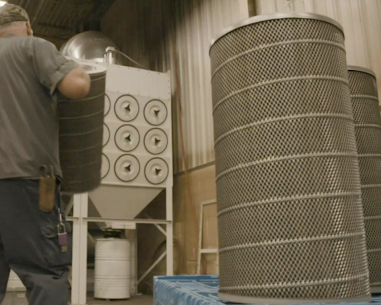
Maintaining proper air quality in industrial environments is non-negotiable — not just for regulatory compliance, but for worker safety and operational efficiency.
However, the costs associated with dust collection system maintenance, particularly replacement filters, can significantly impact your operational budget. What most facility managers don't realize is that premium filtration quality doesn't have to come with premium pricing.
The Filter Industry's Hidden Reality
We have an industry secret that can help lower your maintenance costs: most dust collector companies don't manufacture their own filters. Instead, they source them from just a handful of ISO-rated manufacturers in the United States, then add substantial markups before selling them to end users.
This middleman approach creates an unnecessary cost barrier between you and essential maintenance components. When you purchase OEM-branded filters, you're often paying for brand names and marketing — not superior quality or performance.
Up to 50%
typical OEM price premium
Leading
ISO-rated U.S. filter manufacturers
99%
of replacements built to OEM specs
Breaking Down the True Costs
When comparing OEM filters to high-quality replacement options, consider these cost factors:
Initial Purchase Price
- OEM filters typically cost up to 50% more than equivalent replacement filters
- This price difference compounds with every maintenance cycle
- Larger facilities with multiple dust collection systems face exponentially higher costs
Lifecycle Value
- Filter lifespan should be equivalent between properly manufactured OEM and replacement filters
- Maintenance intervals remain unchanged with quality replacements
- Performance metrics (pressure drop, filtration efficiency) should match or exceed OEM specifications
Long-Term Budget Impact
- Filter replacement represents a recurring maintenance cost
- The savings from using quality replacement filters can fund other critical maintenance projects
- Facilities with multiple dust collectors can save even more in filter cost
Quality Assurance: Addressing the Primary Concern
The main hesitation when switching from OEM to replacement filters typically centers on quality concerns. This is a valid consideration — lower quality filters can compromise system performance, reduce equipment lifespan, and even create regulatory compliance issues.
However, quality replacement filters manufactured to exact OEM specifications eliminate these risks by:
- Following identical manufacturing processes on the same production lines as OEM products
- Matching material specifications, including filter media, construction methods, and design features
- Undergoing rigorous performance testing that meets or exceeds OEM standards
The bottom line on quality: same production lines, same filter media, same performance testing — just without the brand-name markup.
The Manufacturing Truth Behind the Scenes
The dust collector filter industry operates on a little-known model: a handful of manufacturers produce the majority of filters sold both domestically and internationally. These ISO-rated manufacturers have established reputations for quality and consistency.
When you purchase replacement filters from a direct supplier like Air Cleaning Specialists, Inc., there's an excellent chance your filters came from the exact same manufacturing line as the OEM cartridges — just without the expensive branding markup.
In fact, 99% of all replacement filters are manufactured directly to OEM specifications. The rare exceptions occur in cases like the Farr Gold Series, where patent restrictions prevent exact replication of features like the inner cone.
Key Selection Criteria for Replacement Filters
When evaluating replacement dust collector filters, ensure your supplier can verify:
1. Precise Dimensional Matching
- Exact measurements for length, diameter, and pleat count
- Proper end cap configuration for your specific collector
- Correct gasket material and placement
2. Media Equivalence
- Identical filter media composition (cellulose, polyester, blends, etc.)
- Same MERV rating or filtration efficiency guarantees
- Equivalent fire retardant or special coatings if required
3. Construction Quality
- Equivalent pleat spacing and support methods
- Matching material weights and thicknesses
- Identical construction methods (potting, bonding, etc.)
4. Performance Guarantees
- Written assurance of equivalence to OEM specifications
- Comparable warranty coverage
- Return policy if performance doesn't match expectations
Ready to Compare Your Current Filter?
Enter your OEM part number or dimensions and we'll find the matching replacement. Use the Filter Finder →
The Real-World Performance Difference
Before offering any replacement filter, reputable suppliers conduct extensive testing to ensure performance equals or exceeds OEM options. This testing typically includes:
- Pressure drop evaluation under various airflow conditions
- Particulate capture efficiency across multiple particle size ranges
- Structural integrity testing under maximum rated pressure
- Dust loading capacity measurement
- Filter life cycle assessment
The results consistently show that properly manufactured replacement filters deliver identical performance at significantly lower costs.
Making the Smart Financial Decision
For facility managers focused on both performance and budget responsibility, quality replacement dust collector filters offer the best of both worlds:
- ✓ Maintain air quality standards and regulatory compliance
- ✓ Protect valuable equipment with proper filtration
- ✓ Extend maintenance budgets through significant cost savings
- ✓ Receive expert support in filter selection and system optimization
The Bottom Line Advantage
By cutting out the middleman and working directly with the same manufacturers who produce OEM filters, you gain access to identical quality at substantially lower prices. This approach doesn't compromise filter performance or system integrity — it simply eliminates unnecessary markup.
When evaluating your dust collection maintenance strategy, consider the cumulative savings potential of quality replacement filters. Over the lifetime of your system, this single decision can free up thousands in maintenance budget while maintaining the same high standards of air quality and equipment protection.
Maintaining clean air doesn't have to break the bank. With the right supplier partner, you get premium quality filters at affordable prices — without compromising on performance or safety.
100% Money-Back Guarantee: Same Performance as OEM, or Your Money Back
Note: Our replacement filters are designed to match OEM specifications but are not manufactured by the original equipment manufacturers. All performance claims are backed by our satisfaction guarantee.
Frequently Asked Questions
What is the difference between OEM and replacement dust collector filters?
OEM filters are sold under the dust collector maker's brand, while replacement filters are sold by independent suppliers. Most OEM filters are made by the same handful of ISO-rated U.S. manufacturers that produce quality replacement filters, so the main difference is the brand markup, not the filter.
How much more do OEM dust collector filters cost?
OEM filters typically cost up to 50% more than equivalent replacement filters. Because filters are a recurring cost, that difference compounds with every maintenance cycle, especially in facilities with multiple dust collectors.
Do replacement filters last as long as OEM filters?
Properly manufactured replacement filters should have the same lifespan and maintenance intervals as OEM filters, with pressure drop and filtration efficiency that match or exceed OEM specifications.
Are all replacement filters made to OEM specifications?
About 99% of replacement filters are manufactured directly to OEM specifications. Rare exceptions include designs like the Farr Gold Series, where patent restrictions prevent exact replication of features such as the inner cone.
What should I verify before switching to replacement filters?
Confirm precise dimensional matching (length, diameter, pleat count, end caps, gaskets), equivalent filter media and coatings, matching construction quality, and written performance guarantees with warranty and return coverage.
How are replacement dust collector filters tested?
Reputable suppliers test pressure drop under various airflow conditions, particulate capture efficiency across particle sizes, structural integrity at maximum rated pressure, dust loading capacity, and filter life cycle to confirm performance equals or exceeds OEM filters.
Will using replacement filters affect regulatory compliance?
Low-quality filters can create compliance issues, but quality replacement filters made to OEM specifications maintain the same air quality standards and regulatory compliance as OEM filters.
Have more questions? Visit our full FAQ page →
You may also like: