
Nanofiber Filters: Revolutionizing Dust Collection Efficiency
Nanofiber filters increase efficiency and filter life, lower pressure drop, and provide better energy savings than any other dust collector filter media.
Countless industries depend on cartridge filters to clean the air in their facilities and workshops. Switching to nanofiber filters has been proven to increase filter efficiency, improve filter life, lower pressure drop, and provide better energy savings than any other media used in cartridge filters.
Nanofibers were originally developed using the electrospinning method over four centuries ago. Electrospinning was first documented by a physicist named William Gilbert who discovered that a spherical water drop on a dry surface warps into a cone shape when held below an electrically charged amber: this warping became known as the Taylor cone.
Charged jet fluid ejects from the tip of the Taylor cone after the electric field increases, and the repulsive electrostatic force overcomes the surface tension. When the polymer solution jet discharges, it elongates, allowing the jet to become very long and thin. Polymer fibers that are charged, solidify with solvent evaporation and randomly oriented nanofibers are collected on the collector.
Additionally, nanofibers can be collected in a highly aligned fashion through the use of specialized collectors including the rotating drum, metal frame, or a two parallel plates system. Parameters like jet stream movement and polymer concentration have to be controlled to produce nanofibers with uniform diameters and morphologies. Electrospinning transforms many types of polymers into nanofibers.
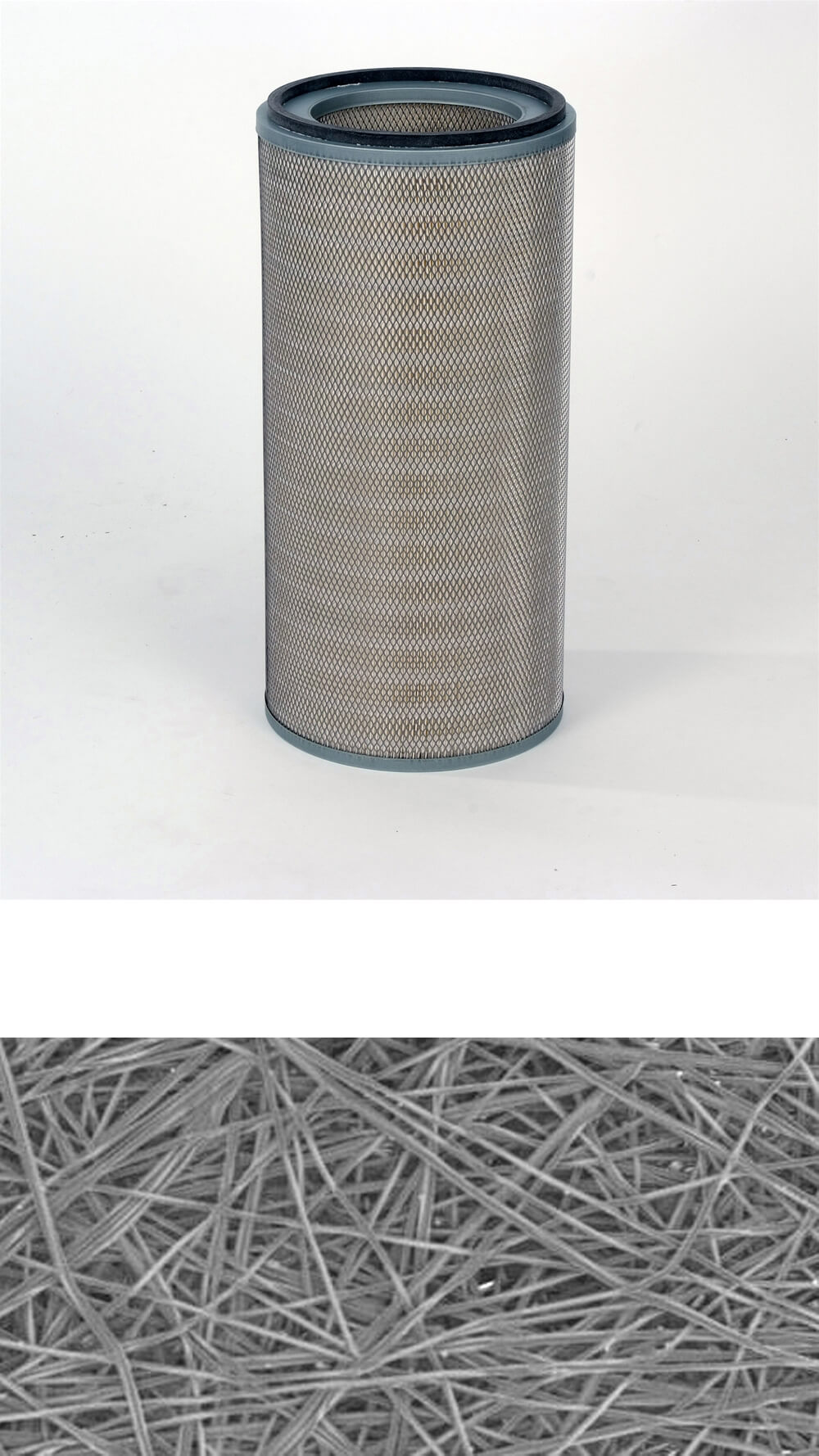
An electrospun nanofiber network resembles the extracellular matrix or ECM, and this resemblance is a major advantage of electrospinning because it opens up the possibility of mimicking the ECM in fiber diameters, high porosity, and mechanical properties.
After the initial discovery of electrospun nanofibers, there were many scientists and academics who saw the potential of future applications and now there are many different techniques used to create nanofibers including chemical and mechanical.
Electrospun nanofibers are highly effective in removing sub-micron contaminants and VOCs and have been proven to achieve faster adsorption and desorption when compared to standard activated carbon because they feature a large surface area and nanopore size.
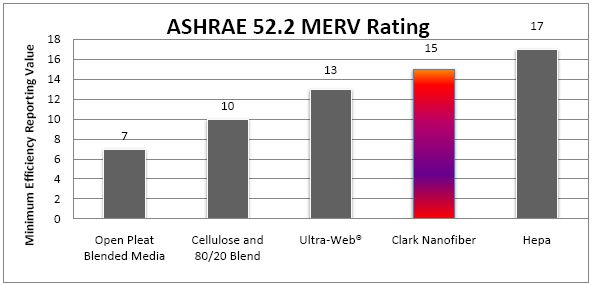
Our nanofiber filters are rated MERV 15. MERV 13-16 filters are generally used in environments that require surgical-grade clean air such as hospitals, labs, and other clean air environments.
Source: Nanofiber
Filter performance is graded by its resistance, airflow rate, particulate count, efficiency, and more. The more efficient a filter is, the higher the MERV rating will be. However, a dust collector filter may have a high MERV rating and not be suitable for your application.
Why Are Nanofiber Filters Better?
Because of their nano-sized pores, nanofiber filters have excellent surface loading capabilities and trap particulate before it embeds deep into the media. When dust is collected, it accumulates on the surface of nanofiber filters instead of within the media, reducing depth loading and requiring fewer pulses to be cleaned. Reduced depth loading and fewer cleaning pulses mean lower energy demands and compressed air consumption.
Due to their high efficiency, nanofiber filters last longer than typical filters which results in fewer filter changes, reduced operational downtime, and overall maintenance and cost savings.
Nanofiber Technology allows for the filter to surface load resulting in lower pressure drop, less pulse cleaning cycles, and longer filter life. The Clark Filter Nanofibers are 50% smaller than the Ultra-Web® fibers and as a result, outperform all other nanofiber offerings in the marketplace. Upgrade from the industry standard and allow your system to run at its optimal potential!
The Clark Filter ProTura™ Nanofiber is 50% more efficient on 0.3 to 1.0 micron particulate than the competition.
Clark Filter is manufacturing ProTura™, the Most Advanced Nanofiber Filtration Technology media and pleated cartridge elements for use in all major brands of Dust Collectors. The finest fibers and highest MERV rating make this the BEST Nanofiber Cartridge Media available anywhere. Welcome to the Next Generation of dust collection media technology available to the aftermarket.
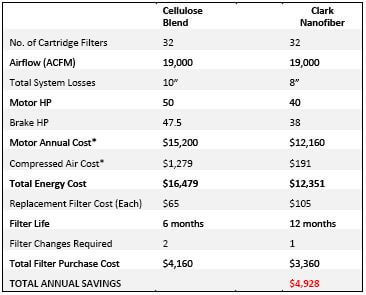
* Based on a dust collection system running 4,160 hr/year and energy cost of 10 cents/kWh
Benefits of Nanofiber Filters
- Most efficient sub-micron particulate filtration
- Rated MERV 15
- Surface-load particulate for easier pulse cleaning
- Lower pressure drops (initially and life-long)
- Superior releasing abilities reduce cleaning cycles
- Reduced energy costs and compressed air savings
- Cleaner air (lower emissions)
- Longer filter life (fewer cleanings/stress)
- Reduced downtime (fewer filter swaps)
- Lower disposal costs (fewer filter swaps)
Our nanofiber filters are 50% more efficient on 0.3-1.0 micron
Ready to upgrade?
Find the nanofiber replacement for your collector, or send us your filter details and a specialist will match it for you.